Reimagining technology in the kitchen space with consumers
The Challenge
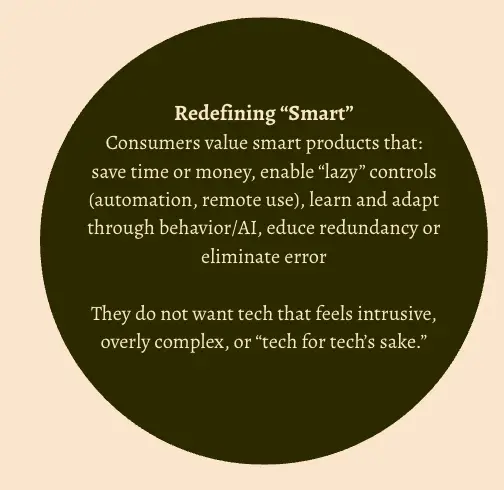
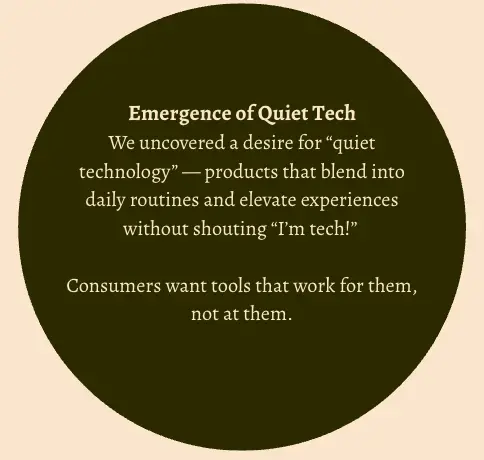
As technology becomes increasingly embedded in the home, our client wanted to understand what “smart” really means to today’s consumers, especially in the kitchen and coffee space. With a rapidly expanding market of connected devices, the goal was not to create tech for tech’s sake, but to uncover what makes technology truly meaningful to people’s lives.
We set out to answer:
How do consumers define and value “smart” technology?
What’s working (and not working) in their homes?
What kitchen/coffee experiences are ripe for innovation?
Where are the gaps between intent and impact?
My Role
Designing and leading the end-to-end research process
Developing recruitment screeners, workshop protocols, and stimulus materials
Facilitating consumer and internal ideation workshops
Conducting post-session synthesis and analysis
Translating insights into opportunity spaces and Jobs to Be Done
Approach & Methods
Pre-Session Homework
Participants identified two key technologies in their lives:
One that positively impacted their day-to-day
One that fell short of its promise
This surfaced early signals of what success and failure look like in the tech-enabled home.
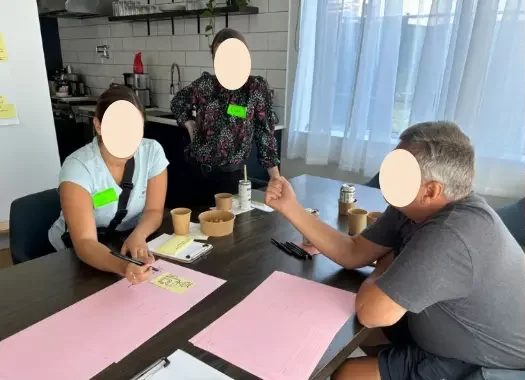
Co-Creation Workshop (Kitchen Environment)
We designed a rich, in-context experience for participants. Activities included:
Icebreakers to surface attitudes around “smart”
Group discussions on current tools, frustrations, and wishlists
Using the Jobs to Be Done and opportunity spaces defined from the Co-Creation Workshop as fuel, cross-functional teams (product, design, engineering) generated over 50+ ideas, later refined and story-boarded for quantitate testing.
These jobs became the north star for concept generation and prioritization.
Idea Generation & Validation
50+ ideas generated in internal workshops
6 concepts selected and story-boarded
Quantitative validation used to assess alignment with consumer needs
Impact
Strategic direction: Research reframed how the organization approaches “smart” products, not as a feature set, but as an enabler of better living.
Product pipeline: The opportunity spaces and Jobs to Be Done directly informed new product briefs.
Cross-functional alignment: Co-creation bridged consumer needs with product, design, and engineering capabilities, accelerating ideation.
Reflection
This project reinforced the importance of meeting consumers where they are, both literally and metaphorically. Creating space for conversation, in a kitchen, not a lab, allowed us to uncover real behaviors, values, and unmet needs. By embedding those insights into the ideation process, we ensured that solutions weren’t just technically feasible, but emotionally resonant and deeply relevant.