Skip to content

Everloved

Driving growth through sustainability and the circular economy

The Challenge

Everlane presented us with a mission to create growth through a customer offering around sustainability and circular economy. 

  • How might Everlane create an offer around resale, reuse and reinvention?
  • How might Everlance customers be incentivized and rewarded within this new economic model?

My Role

Served as Team Lead and Design Researcher for the project which included:

  • Leading internal team coordination and external communication with the client

  • Planning and managing project workflows and timelines

  • Conducting extensive design research, including:

    • Ethnographic observation

    • Consumer and expert interviews

    • Online trend and market research

    • Card sorting exercises

    • Product journey mapping

  • Collaborating with partner (Jordan) to synthesize research findings

  • Co-developed design solution concepts based on research insights

Approach & Methods

  1. In-Depth Interviews

    To establish a well rounded perspective of the industry and sustainability space we interviewed the Director of Sustainability at Everlane, three store owners, five store employees, six customers, a textile industry expert, and a sustainability expert.  

  2. Ethnographic Observations

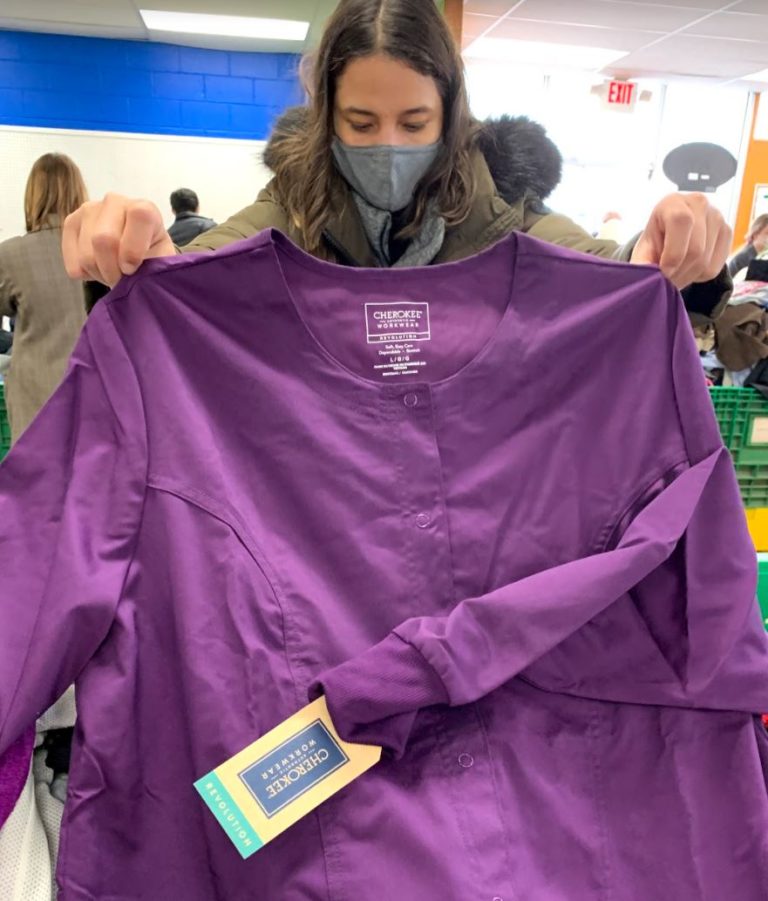
    We visited St. Vincent de Paul Dig & Save Outlet as well as 8 other resale, vintage, and sustainable clothing brand stores to observe the driving behavioral ecosystem of customers and owners and the products that typically flow into these establishments. 

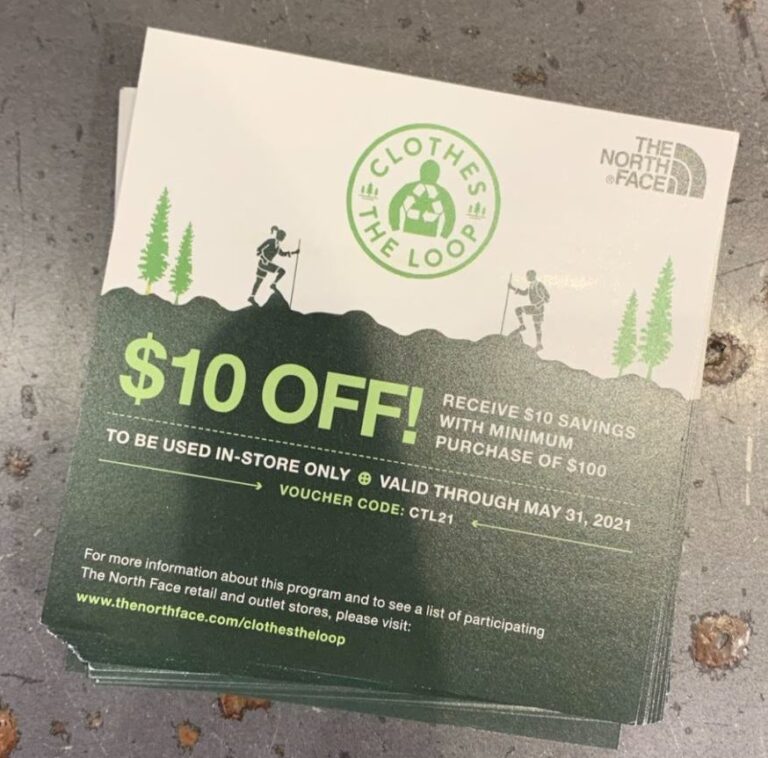
    We also partook in current circular economy programs, specifically the Madewell Blue Jeans Go Green program and the North Face’s Clothes the Loop Program. We noted key similarities and differences in the programs when recycling our own clothing at each store location.

  3. Card Sorting 

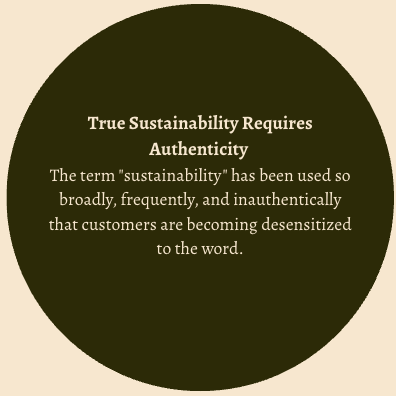
    To fully understand the current perceptions of brands and sustainability programs we conducted two card sorts. The first card sort was focused around perception of different brands, including quality, sustainability, inclusivity, and alignment to personal identity. The second card sort was geared towards openness to participating in sustainability programs and practices. 

  4. Competitive Analysis 

    The competitive analysis was conducted to assess the current landscape of clothing retailers and their sustainability impact.

  5. Journey Mapping 

    We assessed adjacent industries’ ownership journeys and better understand how users purchase, care for, and dispose of their assets. 

Key Insights

Opportunity Areas

Increase the lifespan of products after initial purchase through continuous care, reusing and recycling.

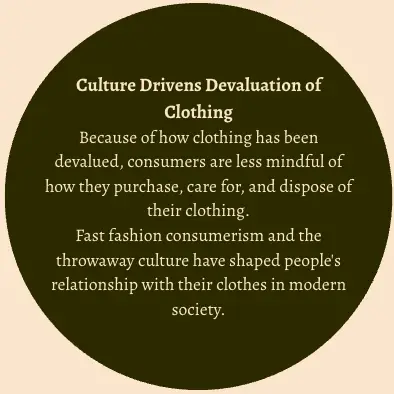
Why it matters: An article of clothing is worn on average 7 times before is it discarded. The decreased lifespan needs to be addressed in order to keep clothing out of the landfill.


What we can do: We have an opportunity to lead the transformation of the current linear clothing life cycle into a circular one. becoming the shepherd that guides consumers to mindful clothing care and consumption habits will distinguish Everlane in the retail space and inspire its competitors.

Expand radical transparency to include educating customers about the production of their clothing, from field to closet.

Why it matters: The fashion industry is the second-biggest consumer of water and responsible for 8% of carbon emissions.


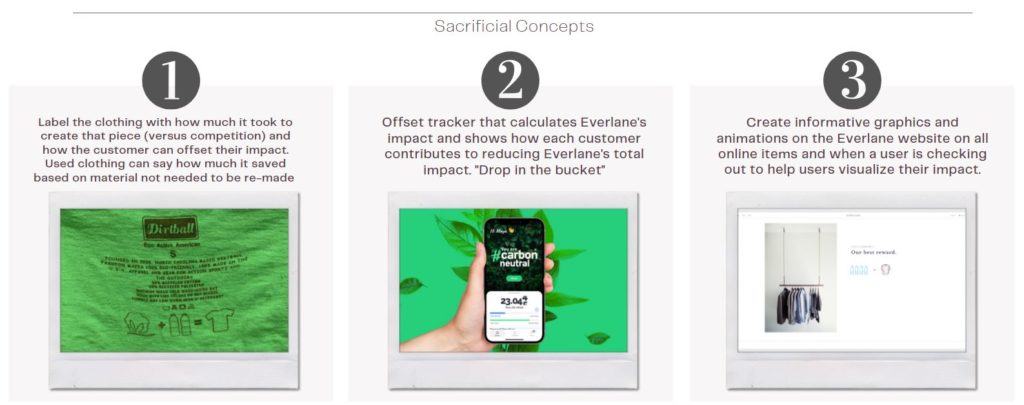
What we can do: Providing a radical education to consumers will allow them to understand the impact of each piece that they consume, and through this, we can promote mindful purchasing and inspire change to offset their impact and value their clothing in a new light.

Maximize the status that Everlane has in the minimalism space and connect the idea of living simply to sustainability.

Why it matters: Buying less is better than buying green or more sustainable items.


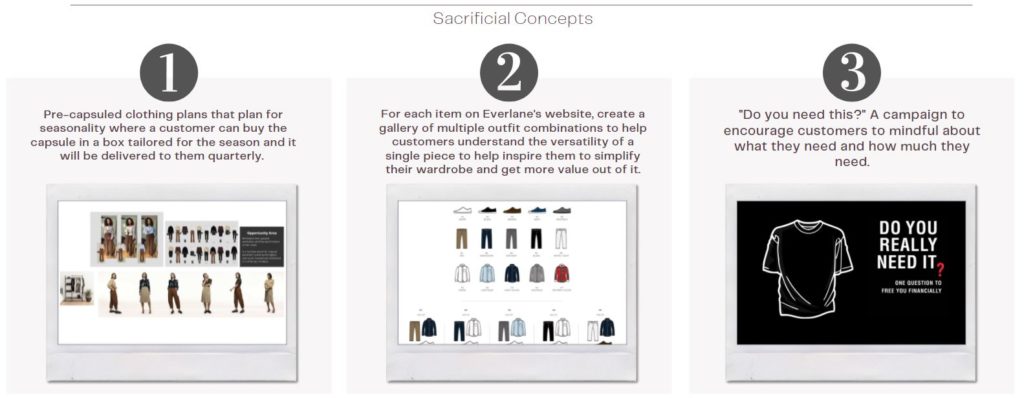
What we can do: Encourage customers to only buy what is essential. This will help them make more thoughtful purchases, minimize their environmental impact, and communicate that Everlane is a responsible company.

Prototyping

Early Concept Development

Streamlined Consumer Experience 

Initial Sketches focused on building a customer experience where purchased clothing can be registered in a “closet” by scanning a QR code or through taking a picture using computer vision. This would then pull up the product page where customers can review the item in more detail.

Educational Opportunity

The product page would also act as an educational touchpoint where users can learn about the environmental impact of each article of clothing. 

Fully Integrated

After further brainstorming and reflection we found that the best option to improve the overall adoption and usability experience was to integrate the Everloved product and information directly into the purchasing experience.

Initial Prototype Development

Figma Prototypes Developed For The Following Experiences  

  1. Everloved Menu

  2. My Closet’s Impact

  3. Closet Catalog

  4. Product Detail Page (and an Issues Modal Window for the screen)

  5. Product Care

  6. Product Care Video Content

  7. Everlane X thredUP


Prototypes were built to be embedded into the current Everlane product detail pages.

Product Testing

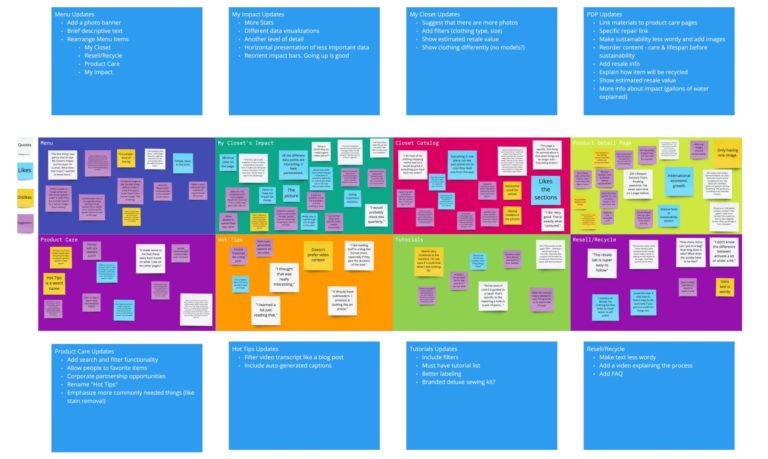
We tested our prototype with four users and received additional feedback from our classmates and professors. The product testing was focused on first impressions and content to ensure we were in line with customer’s interests and expectations.  

We received both positive and constructive feedback in each product area that lead to iterative prototypes. These prototypes were further tested with a focus on mitigating risk in two main areas: My Impact and Repair.

Mitigating Risk

Risk Area 1: My Impact 

Testing: Usability Testing (Impression)

  • Enable education without the negative feelings
  • Ease of comprehension of the information communicated
  • Duality of positive and negative impact balancing and the emotions associated (credit score)
  • How to incentivize sustainable actions

Risk Area 2: Repair

Testing: Usability Testing & Survey

  • How people see their clothing issues
  • Customer willingness to take advantage of the education
  • Ideal education format, time length and skillset Most desirable skills and knowledge to acquire

Final Prototypes & Experiences

Everloved by Everlane

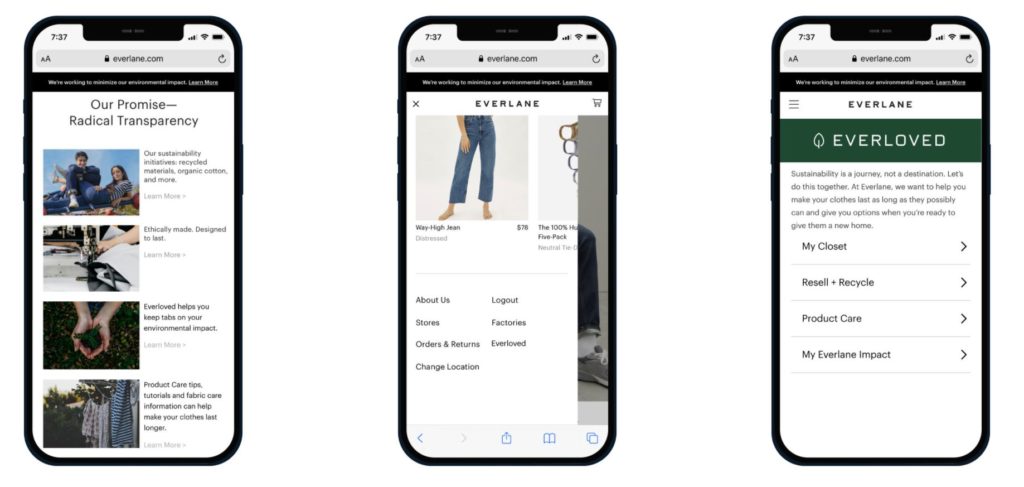
Everloved is a new product offering within Everlane’s current website that educates customers about their impact and creates actionable opportunities to change their behavior for the betterment of the planet.

Everloved can be accessed through everlane.com. It will be made discoverable through email campaigns, and social media marketing.

My Closet

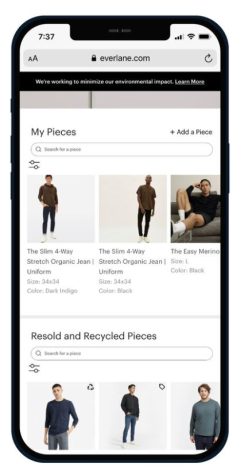
On the My Closet page, users can view the pieces that they have purchased as well as pieces that they have resold or recycled. These pieces are integrated automatically from their orders. Pieces can be searched for or filtered using the search bar and filter functionality.

If a user receives an Everlane item as a gift or buys secondhand, they can still reap the benefits of Everloved by manually entering their item by tapping on + Add a Piece.

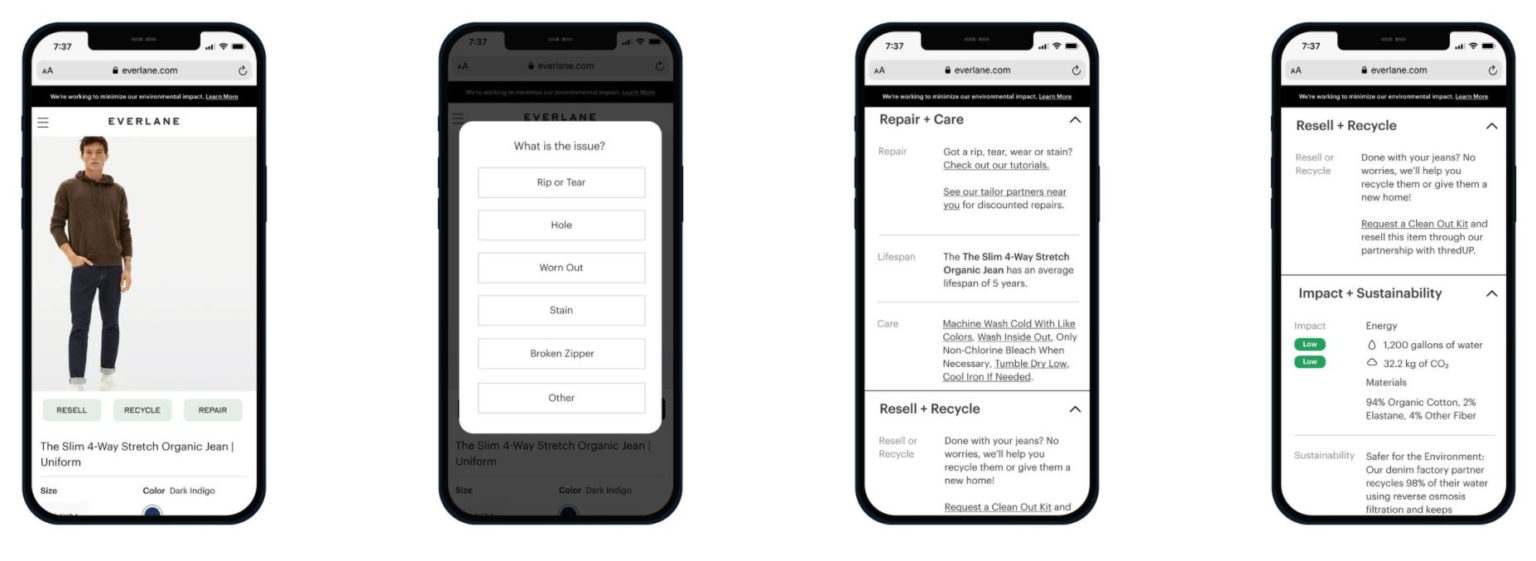
From the product detail page users can access the Repair & Care, by tapping on the repair button, which will then bring up a menu of potential product issues. Once an issue is selected, tutorials and videos on how to repair the item will show. 

The product detail page also uses education as a core component of Everloved. Care information on the page is clickable and takes users to Product Care tips and tutorials where they can learn more about how to care for the fabric or material, learn about the lifespan of the piece, and learn about the environmental impact and sustainability of the piece.

My closer 1

My Everlane Impact

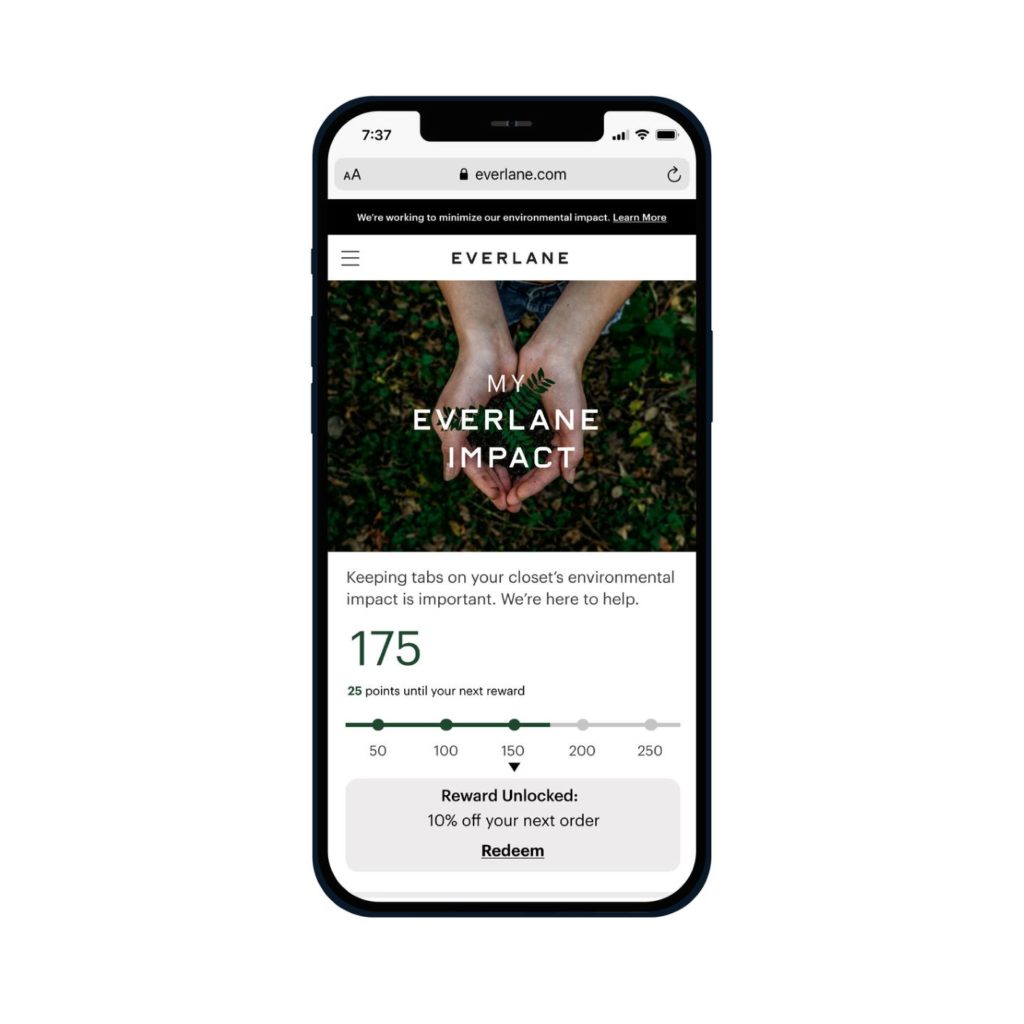
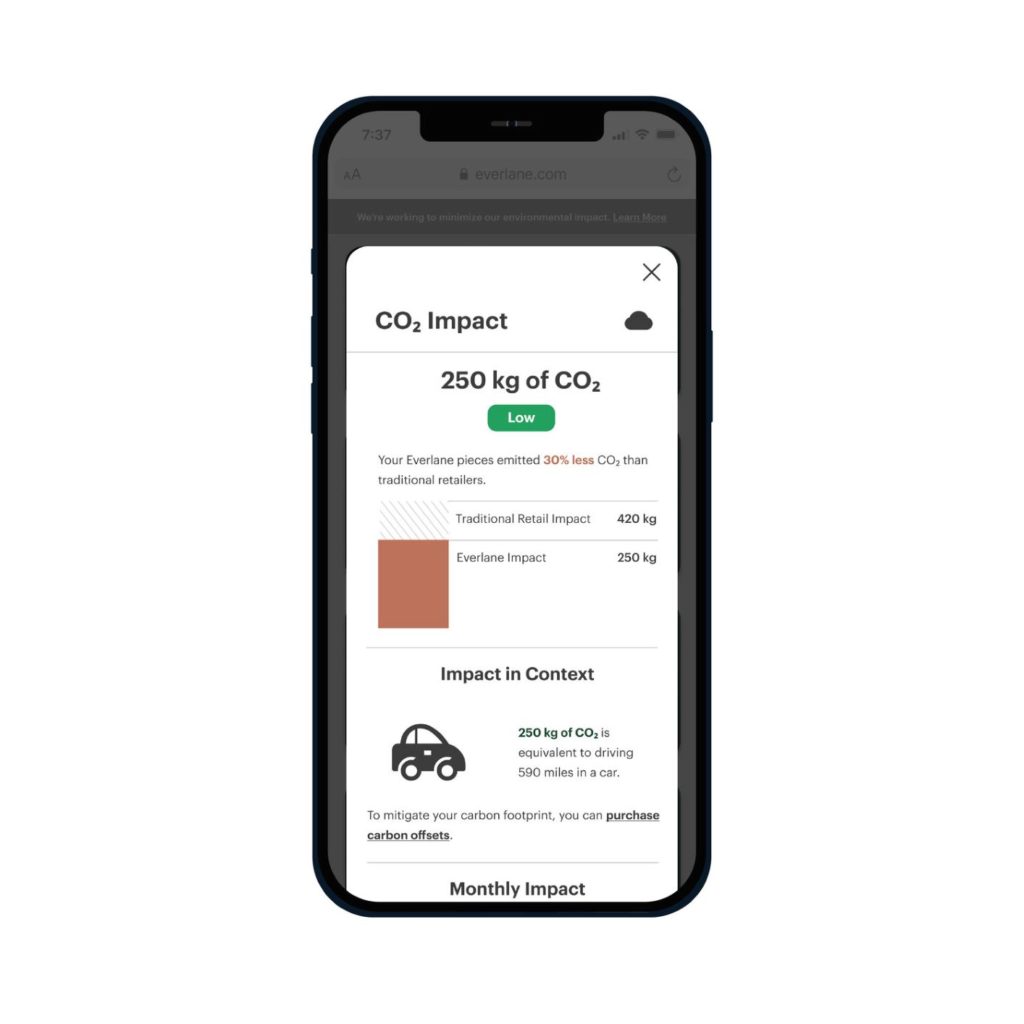
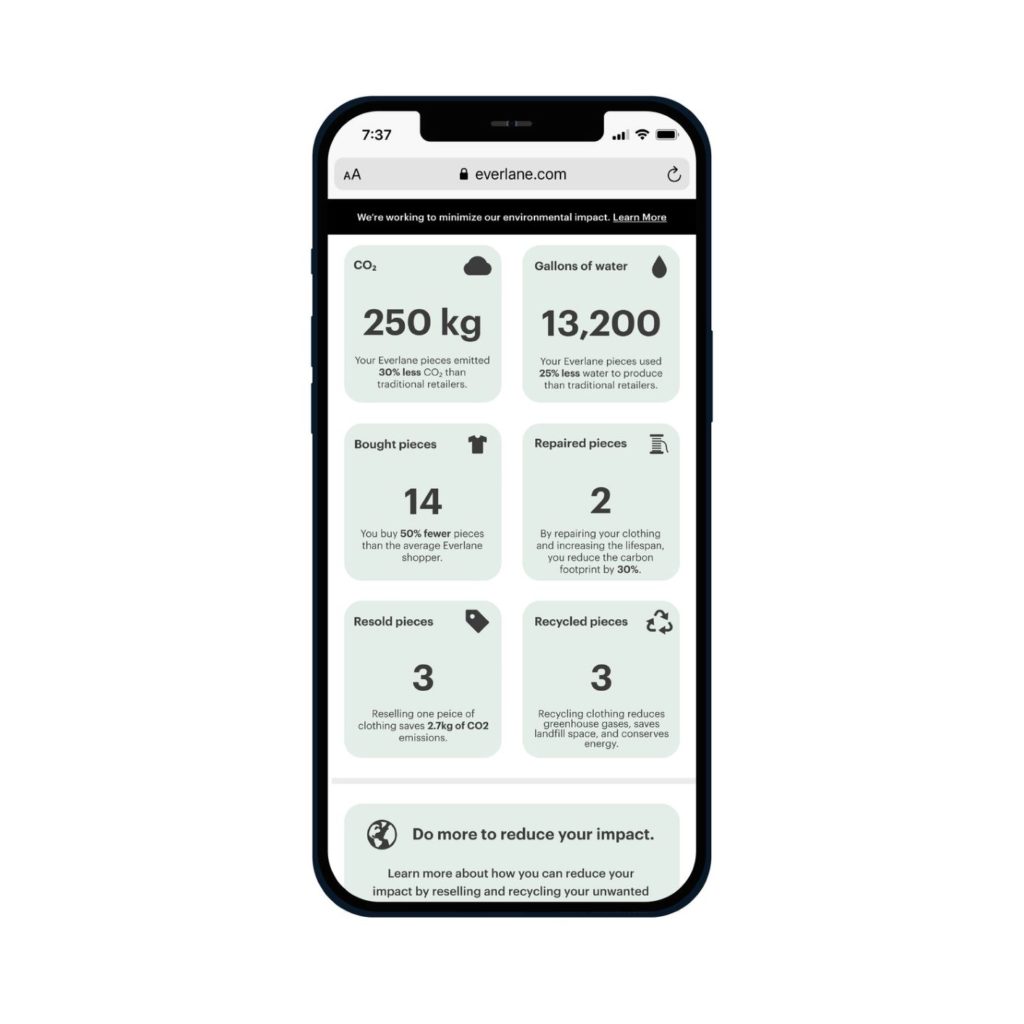
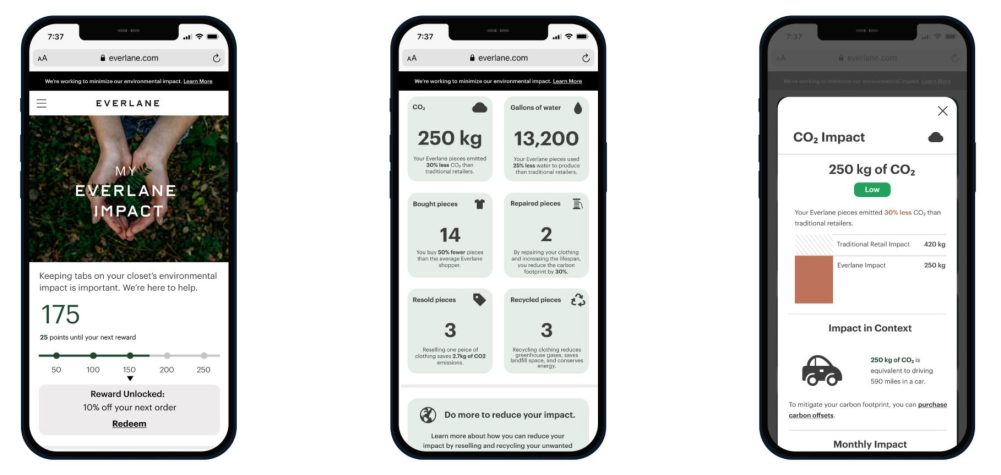
The My Everlane Impact allows users to view their Impact points that they’ve earned from reselling, recycling or repairing their items. They can also review their total environmental impact for related to CO2 and water, the number of pieces they’ve bought, repaired, resold, and recycled and see other options they have to reduce their impact. 

On the Reduce Your Impact page, users are directed toward more ways that they can reduce their impact through buying used clothing, repairing, reselling, and recycling clothing, and through purchasing carbon offsets.

Offset Your Carbon Impact allows users to offset their CO2 emissions by purchasing carbon offsets through Everlane’s partnership with Native Energy.


impcat

Resell & Recycle

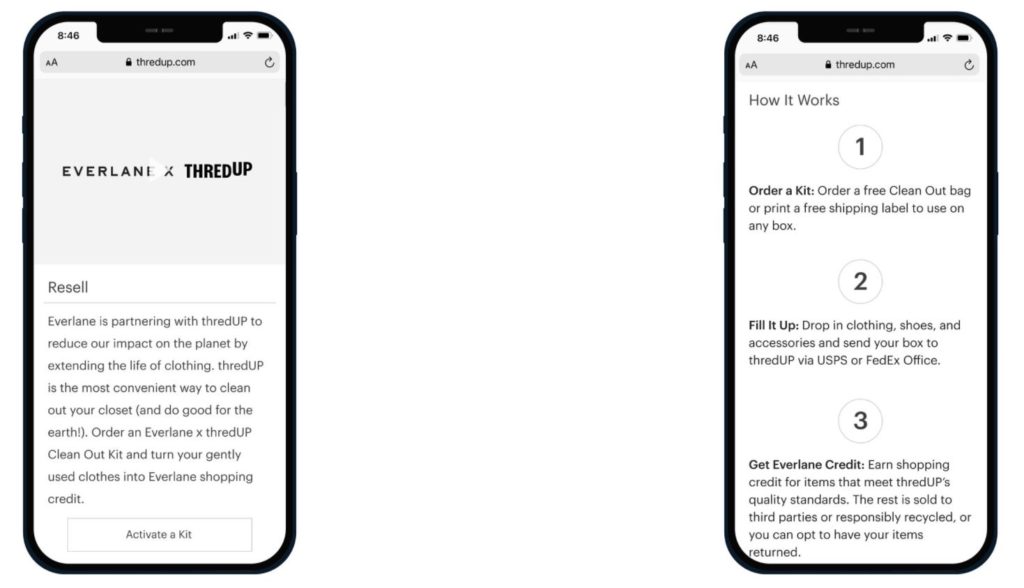
The Resell & Recycle page connects directly to ThredUp partnership page. Users will have ability to request a cleanout kit to either resell or recycle their gently used items. The partnership with ThredUp alleviates the operational needs to fulfill a resell/recycle supply chain. Customers will then have the ability to use this credit on ThredUp or everlane.

The Everloved Journey Experience

We created user journeys to better illustrate how Everloved would be discovered, utilized, and integrated within Everlane’s current ecosystem. 

Conclusion & Reflection

Everloved provides value to both Everlane and their customer through honest brand connection and a transparent circular economy model. This project has demonstrated the importance of uncovering the full holistic picture to better understand both the client and consumer in a way that authentically serves both.

Everlane Value

Build credibility within the sustainability space and evolve what radical transparency means.

Collect data on common issues customers have with clothing to improve upon designs in the future.

Entice customers to replace their resold or recycled items through Everlane with the partnership with ThredUp.


Consumer Value

Build trust with a brand and feel confident in their purchasing decisions.         

Empowered to take ownership over their clothing and assured in their ability to increase the longevity of each piece.

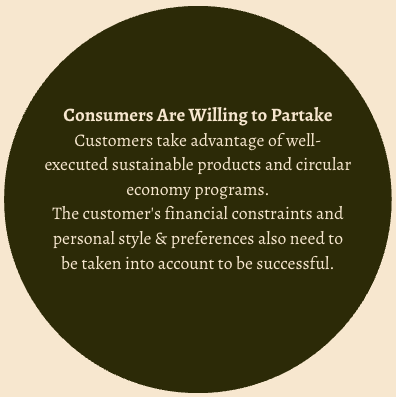
Incentivized to participate in the circular economy model.

Future Development Opportunities

My Closet

  • Minimalist closet settings and recommendations
  • Allow customers to add other clothing brands into My Closet
  • Allow customers to mix and match clothing to create their own outfits
  • Connect My Closet to the retail product pages for easy reorders and recommendations

My Impact

  • Expand impact to include customer events/activities to reduce their impact
  • Establish a branded Clothing Impact Label
  • Create Everloved ambassador programs for students with sustainability focus

Product Care & Repair

  • Create repair and product care classes for in person learning
  • Develop a custom Everloved sewing and repair kit
  • Launch a care specific channel through social media under Everloved
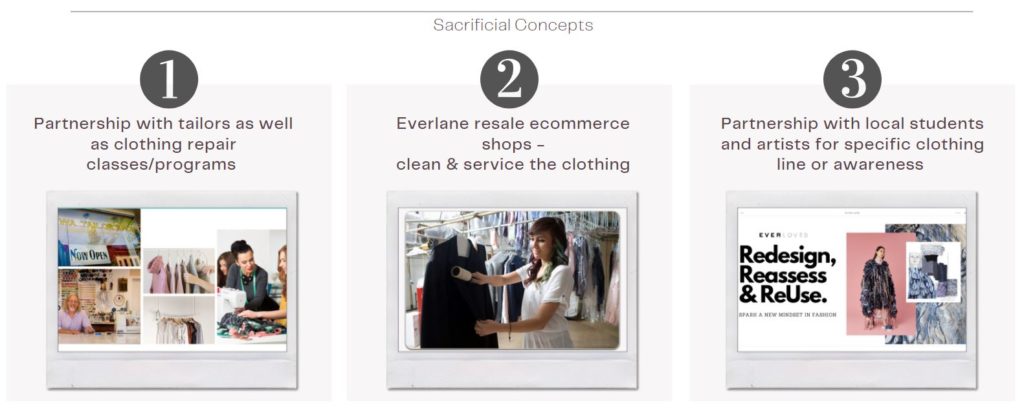
  • Partnerships with local tailors and dry cleaners
  • Refine Product Care to be more area specific for in-depth data collection

Resell & Recycle

  • Develop or acquire infrastructure to resell Everlane clothing within the website
  • Develop the infrastructure to reclaim and recycle worn clothing into into new materials for Everlane lines
  • Upcycle programs with local artists and designers to reclaim old product and turn it into something new